Mostrando entradas con la etiqueta Georgia. Mostrar todas las entradas

jueves, 1 de octubre de 2009

EU Investigators Debunk Saakashvili's Lies

New Report on Russia-Georgia War

By Benjamin Bidder in Moscow
Zoom - AP - Der Spiegel

In this Sept. 4, 2008 photo, a girl plays near a ruined building in Tskhinvali.

The EU fact-finding mission on the Russia-Georgia war has published its findings in a much-anticipated report. The authors blame Georgia for the war but also assign partial responsibility to Russia. Both countries have reacted angrily to the findings, with the Russia ambassador to NATO saying the report is only "pseudo-balanced."

The truth about the war between Russia and Georgia over the breakaway republic of South Ossetia in August 2008 sounds somewhat convoluted, at least as expressed in the final report of the independent EU fact-finding mission charged with establishing the causes of the conflict. "Georgian claims of a large-scale presence of Russian armed forces in South Ossetia prior to the Georgian offensive on 7/8 August could not be substantiated by the mission," reads the document, which was published Wednesday. To put it more simply: It was Georgia who started the war.

This is the conclusion that the team of European investigators, headed by the Swiss diplomat and Caucasus expert Heidi Tagliavini, have reached after spending almost a year visiting the Georgian capital Tbilisi, Moscow and the locations of the fighting in a bid to reconstruct the course of the conflict. Their findings fill some 1,000 pages.

Just a few days ago, Georgian President Mikheil Saakashvili had insisted in an interview with US broadcaster CNN that no one took seriously reports that his country was responsible for the war. Responding to an interviewer question about a recent SPIEGEL story which reported that the EU committee had put the blame for the conflict on Georgia, Saakashvili said: "Everybody who was there, and there were serious people there, everybody knows what happened." According to Saakashvili's version of events, which he had distributed officially in a government report on the war, the night-time attack by Georgia on the breakaway region of South Ossetia on Aug. 7, 2008 was a preemptive strike directed against Russian armored columns which had supposedly already advanced into South Ossetia.

Already on the first day of the war, the brawny Georgian General Mamuka Kurashvili appeared on television in his dress uniform and boasted that Georgia had decided to "reestablish constitutional order in the entire region."

Indignant Reactions

The EU report, which is extensive, detailed and well-informed, makes clear that the Georgian claims are completely fabricated. "It was Georgia which triggered off the war when it attacked (South Ossetian capital) Tskhinvali" said Heidi Tagliavini, the mission head, in a statement. Although the EU commission tactfully avoided using the word "lie," the report implies that Saakashvili did not tell the truth about how the war started.

Tbilisi is now predictably outraged at the results of the fact-finding mission. Georgia did not by any means use "disproportionate force," stresses Georgian Reintegration Minister Temur Yakobashvili. "We see Russia's actions as aggression, because the country invaded the Tskhinvali region with its troops."

Russian politicians, for their part, feel that the report's conclusions strengthen their position. "If the commission has acknowledged that it was Georgia who started the war, as Russia has repeatedly said, we can only welcome such a conclusion," said Natalia Timakova, a spokeswoman for Russian President Dmitry Medvedev.

'Ambiguous Formulations'

Yet the triumphant mood in Moscow was tinged by a hint of bitterness. "The report has a major flaw," complained Sergei Makarov, a member of the Duma for the Kremlin party United Russia and a member of the Parliamentary Assembly of the Council of Europe. "It does not address the US's role in the conflict."

In a statement, the Russian Foreign Ministry also expressed its resentment about "ambiguous formulations" in the report -- a reference to passages in which the authors make it clear that they consider Russia to have been partly responsible for escalating the conflict. The report concludes that the mass issuing of Russian passports to South Ossetians, as well as to residents of another breakaway republic of Abkhazia, was in violation of international law. It also criticizes the fact that Moscow trained and armed South Ossetian troops.

In addition, the report's authors conclude that the reason given by Russia to justify the campaign to its own population was completely unsubstantiated. The Russian authorities had claimed that the Georgians had committed a previously planned genocide against the South Ossetian people. According to Kremlin propaganda, the Georgian offensive caused 2,000 deaths in a single night. Russia later reduced its figure for total South Ossetian civilian casualties to 162. "Although it should be admitted that it is not easy to decide where the line must be drawn, it seems, however, that much of the Russian military action went far beyond the reasonable limits of defense," the European investigators conclude.

Sentences like this one have irritated the Russian ambassador to NATO, Dmitry Rogozin. "This report has a pseudo-balanced approach," Rogozin told SPIEGEL ONLINE. "All the parties are criticized a little, including the Ossetians, the Russians and Georgia's Western patrons. But one no longer sees the wood for the trees."

According to Rogozin, the key thing is that the EU mission has clearly stated that Georgia started the hostilities. "But if the Russian military response has been criticized as being too harsh, then this is surely a matter of taste," Rogozin complained. "I certainly think it was still too lax."

miércoles, 3 de junio de 2009

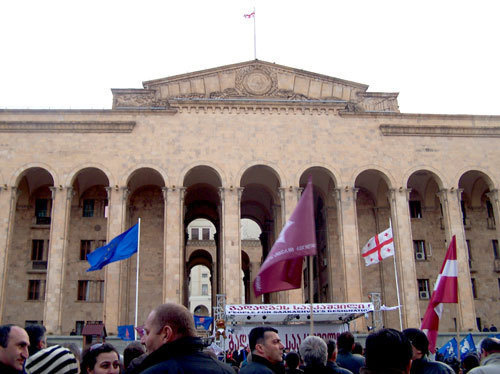
Tens of thousands of people on the stadium demand resignation of Georgian president

The Opposition leaders' board next to the Parliament, the 26th of May, 2009. Photo by "Caucasian Knot"

The central stadium of Tbilisi, Georgian capital, with the 80,000 capacity is overcrowded. Tens of thousands of opposition representatives and their supporters, including oppositionists from West Georgia headed by Giya Gachechiladze, well-known singer and brother of the opposition leader Levan Gachechiladze, have gathered in order to mark Georgian Independence Day and demand resignation of Michail Saakashvili, Georgian president.

The "Caucasian Knot" correspondent reports that the event is broadcast live in Tbilisi and across regions by the TV channel "Maestro". According to different sources, the opposition event is attended by 65,000 to 100,000 people, including opposition leaders.

Malkhaz Varshanidze, documentary films director, who is at the stadium now has told the "Caucasian Knot" correspondent that there are no vacant seats at the stadium, that people already stand on the race tracks and on the pitch, and more and more people arrive.

Irakli Alasaniya, leader of the "Alliance for Georgia", thinks it is possible that, after today's event, opposition parties may expand their activity along three lines. One part will continue street actions for maintaining the feelings of protest among the community, another part will embark on the path of negotiations while continuing to demand that the authorities should comply with the six-item memorandum. The third part will expand its activities abroad in order to involve the western community into a more active participation in the internal processes of Georgia.

Levan Dachicheladze, one of the opposition leaders, states that the opposition is not a political alliance alone. If opposition parties apply different tactics for attaining their goal, i.e. resignation of Georgian president Michail Saakashvili and appointment of early presidential election, this may expand the range of protests.

The Georgian authorities have decided not to interfere with oppositionists and cancelled the traditional Independence Day military parade along Rustaveli Avenue which the opposition promised to frustrate.

Sources at the Georgian MFA note that during Independence Day a gala concert is arranged at the Opera and Ballet Theatre at 18.00, attended by ambassadors, members of the government and artists, while a traditional reception is planned at 20.00 in the hotel "Sheraton Metekhi Palace".

See earlier reports: "Georgian Prosecutor's Office investigates police actions at detaining persons accused of a riot in Mukhrovani," "Director general of the TV company "Maestro" claims the explosion in Tbilisi may have been connected with the film about Ghirgvliany," "Oppositionists are on march from Batumi to Tbilisi."

Author: Tamaz Imnaishvili; Source: CK correspondent.
Caucasian Knot, may 26 2009, 20:00

martes, 5 de mayo de 2009

Georgia Alleges Russian Role in a Coup Plot

Vano Shlamov/Agence France-Presse — Getty Images
Georgian security forces on their way to the Mukhrovani army base near Tbilisi on Tuesday.

Published: NYT, May 5, 2009

TBILISI, Georgia — Georgia announced Tuesday that it had put down a brief military mutiny that aimed to disrupt NATO military exercises, ratcheting up tensions a day before the exercises are scheduled to begin over Russian objections.

Georgian forces surrounded a tank battalion 25 miles outside of Tbilisi, whose leaders Georgia accused of planning the uprising. A few hours later, most of the unit’s 500 soldiers surrendered, and several of their commanders were detained.

President Mikheil Saakashvili said Russia was hoping to derail the military exercises, which he called a “symbolic event.”

“We are asking our northern neighbor to refrain from any provocations,” he said, in a televised interview.

Russia immediately denied any role in the unrest.

“This is not the first time we have been accused of interference without evidence,” said a statement from the Ministry of Foreign Affairs. “We would like to reiterate that Russia, as a matter of principle, doesn’t interfere in Georgia’s domestic affairs.”

The exchange raised the already high temperature ahead of the exercises, run by NATO’s Partnership for Peace program, which includes nonmembers. NATO has described the plan as routine and small-scale — around 1,000 soldiers will take part in field exercises — but Russia complains that, less than a year after its war with Georgia, any NATO training there are provocative.

Armenia, Serbia and Kazakhstan have said they will pull out of the exercises in solidarity with Russia. Foreign Minister Sergei V. Lavrov notified NATO on Tuesday that Russia was pulling out of a long-anticipated NATO-Russia Council meeting scheduled for May 19 in Brussels in protest of the exercises, as well as NATO’s expulsion of two Russian diplomats on suspicion of spying.

Carmen Romero, a NATO spokeswoman, said Secretary General Jaap de Hoop Scheffer “regrets this decision” and hopes to reschedule the meeting soon.

She said the exercises would go on as scheduled.

Dmitri O. Rogozin, Russia’s envoy to NATO, warned that the exercises “may significantly affect the stability of the entire South Caucasus.”

“How can one insist on these exercises with such stubbornness and persistence?” he said, in comments aired on Russian television. “If these exercises were held at NATO’s insistence in some psychiatric hospital it would be a much more adequate decision than holding them on the territory of the Georgian state.”

Details of the Georgian mutiny emerged throughout the day on Tuesday, leaving many in the capital glued to their televisions.

Shota Utiashvili, a top official in Georgia’s Interior Ministry, said authorities learned at 6:30 a.m. that a tank battalion stationed at Mukhrovani — five miles from the site of the planned military exercises — publicly announced a mutiny. He said the unit’s 500 soldiers had sealed off the base and would not allow Ministry of Defense officials to enter.

“What happened is that battalion commanders told the soldiers that the Russians were attacking them and they had to take combat positions,” Mr. Utiashvili said. Around noon, he said, the soldiers learned from news reports that their commanders had misled them and surrendered. Authorities “didn’t know the scale of the mutiny” and were relieved to discover that it was small and isolated, he said.

In the morning, officials confidently asserted a Russian hand in the plan, but by afternoon they were more cautious. Mr. Utiashvili said it is “not exactly clear” whether the accused plotters had Russian support.

“To have a legally sound case we need more information,” he said. “This morning we had some evidence, and from that evidence one would follow that Russia was involved.”

Incriminating surveillance footage was broadcast all day on Georgian television.

In a video, which had been edited, Gia Ghvaladze, a former major in the Georgian special forces, describes plans to overthrow Mr. Saakashvili’s government on behalf of Russia. Mr. Ghvaladze says the plan was to approach Tbilisi with a column of 250 troop carriers and backup from 5,000 Russian troops, and talks about killing six of Mr. Saakashvili’s closest advisors.

Mr. Ghvaladze was arrested Monday night on charges of organizing a mutiny. By Tuesday evening, police had arrested 13 suspects, according to the Interior Ministry.

The unfolding events left much of Tbilisi spellbound — or paralyzed. Traffic thinned out on the city’s streets, and when Natia Kuprashvili, 29, tried to teach her class at Tbilisi State University, her students’ cell phones began to ring so wildly that she gave up and went in search of a television.

But in the end, she said, “it is very hard to understand what really happened here.”

Roman Apakidze, 30, concluded that a mutiny did take place, but that the government was distorting it for political purposes.

“I just don’t like the way the government is handling this information — it is real information terror against ordinary people, what they do,” he said. “It is better not to turn on the television at all.”

Olesya Vartanyan reported from Tbilisi, Georgia, and Ellen Barry from Moscow.

jueves, 16 de abril de 2009

Data on the number of Tbilisi protesters diverge

The opposition rally at the Parliament of Georgia. Tbilisi, April 9, 2009. Photo by "Caucasian Knot"

apr 09 2009, 21:00

Georgian journalist Irakliy Berulava, who is present in the venue, has treated the data about the number of participants in the protest rally in Tbilisi, reported by some mass media, to be frankly false.

"As to 50 or 80 thousand persons in Rustaveli Square - it's a lie. If we do an absolute approximation, there're some 20-25 thousand protesters - this is maximum. But the leaders of the opposition have obviously not expected this," Mr Berulava said to the "Caucasian Knot" correspondent. He has quoted the latest speeches of oppositionists.

"President of Georgia has failed to answer the hopes imposed on him in November 2003," said Irakliy Alasaniya, leader of the "Alliance for Georgia". In his opinion, President Saakashvili had promised to unite the country and solve social problems, but failed to do it. "He has exhausted out people's patience and should resign," Berulava quotes speakers as saying.

In the course of his appeal, Mr Alasaniya has also stated that the change of power should be "exclusively peaceful and gained through people's endurance."

Irakliy Berulava reports that the speech of Levan Gachechiladze, former leader of the United Opposition, was tougher and more radical. "Misha, leave before we've come! You have no right to rule the country! A coward is not wanted here!" Mr Berulava quotes Mr Gachechiladze as saying.

In her turn, Nino Burdzhanadze, ex-speaker of Georgian Parliament, has apologized for "being in power and unable to save the nation from tyranny."

However, Georgian and Russian media give highly diverging data about the number of participants of the rally. The "Newsru.com" Internet-based edition wrote at 4 p.m.: "According to different sources, in the square in front of the Parliament, in Rustaveli Avenue and adjacent streets there are from 120 to 130 thousand persons."

"It's a usual case of 'political mooneye', typical for all rallies. If an assembly is in support of official power, the media fed from the state crib will write that the rally was, say, 50,000-strong, while the opposition, covering the same action will write - 5000," Mr Berulava has noted. "Same with opposition's actions."

"The point is how you count. The Ministry of Internal Affairs (MIA) counts persons per square meter with account of the crowd density and the total area filled. Such data is not absolutely exact, but close to reality. But here we have one subtlety - these data is for an internal official report. For the media it'll be announced as prepared in bosses' offices," Dmitri Berkut, a former employee of special MIA's subdivision said to the "Caucasian Knot" correspondent.

See earlier reports: "Ivanishvili: Georgian authorities get ready to April 9, soldiers had to give away their mobile phones," "Six activists of movement "Why?" detained in Georgia," "President of Georgia invites opposition to dialogue."

Author: Dmitry Florin; Source: CK correspondent

jueves, 24 de enero de 2008

Yezids

Yezids or yazidis is a sect dwelling principally in Kurdistan, Iraq, Turkey, Syria, Armenia and Georgia, who call themselves Dasni and claims to have originated in India 6,000 years ago. Their population is now estimated to be less than one million worldwide.

As far as their memory goes back the Yezids– one of the minorities in Armenia- have been engaged in highland cattle breeding.
There are two theories about the origins of the Yezids: one says that the Kurds are their ‘forefathers’; the other says exactly the opposite; that the Kurds came forth from the Yezid. Whatever the truth, the main difference between these two peoples is that the Yezids have preserved their religion for nearly 4 millennia.

The Yezidis were Kurmanji Kurdish-speaking (a dialect they call Ezdiki or Yezideren), but many of them did not consider themselves Kurds, because they’re not Muslims, but Sharfadin. In fact, the Yezidi religion is the original faith practiced by the Kurds before most were converted to Islam. The first mentioning of the Temple of the Yezid is related to the ancient town of Babylon and today the most important temple is located in Lalish, north of Mosul, Iraq.

The Yezids worship the sun, the goats and their most important deity created the world while looking at the beauty of a peacock angel or demiurg they call Tawsy Melek, Melek Taus, Taus-e-Malak, Al-Kadir, Azazel, Aziz or Shaytan. Since the Qu’ram reserves this name for Satan, often the Yazidis have been erroneously identified as devil worshipers. Such deity is the leader of Seven Holy Beings, who reincarnates periodically in human beings in a process called koasasa (metempsychosis). Even if dismissed as devil worship, Yezidism in fact combines elements from Zoroastrianism, Islam, Christianity, and Judaism. They celebrate the New Year’s day on the first Wednesday of Nisan (March/April), as they believe God created Melek Taus on this day.

Because of the identification Muslims made with a satanic sect, and due to their pre-Islamic beliefs, they have been oppressed by their Muslim neighbors. Treatment of Yazidis was exceptionally harsh during the rule of the Ottoman Empire during the 18th and the first half of 19th century and their numbers dwindled under Ottoman rule both in Syria and Iraq. Massacres at the hand of Ottoman Turks and Muslim Kurdish princes almost wiped out their community in the 19th century. They were murdered as if they were armenians during the Armenian Genocide of 1915 in Ottoman Turkey.

For the Yezid the peacock is therefore a holy animal and its image can be found on their pillows, blankets and in their tents. The Yezids do not have a Holy Book and their religion is based on the knowledge of their priests. The right to become a priest is inherited once sufficient knowledge has been gained. The most important ritual is the annual six-day pilgrimage to the tomb of Sheikh Adi in Lalish, north of Mosul, Iraq.

Yazidi society is hierarchical. The secular leader is a hereditary emir or prince, whereas a chief sheikh heads the religious hierarchy. The Yazidi are strictly endogamous. Within Yezid society there are three major castes below Mir (the yazidi prince) and Baba Shiekh (a kind of Pope): Sheikhs, Pyrs and Murids (lowest caste). Marriages are allowed only inside the castes and sometimes the bride does not know her future husband. Society is strictly regulated with rules and taboos that are passed on from generation to generation, e.g. the bride cannot talk to the oldest man in the family or eat in his presence before the marriage. Besides the caste system, the roles of men and women in Yezid society are also strictly defined according to tradition.

Yezids have a rich tradition of celebrations: at weddings for example the groom throws an apple at the bride’s head and the more pieces it breaks into the better. The New Year (Sere Sal) celebration includes the coloring of eggs, the Parade of the Sanjaks (bronze lamps with peacocks), remembrance of the dead on the cemetery, where the tables for the ceremonies by the graves are divided into sections for men and women. Many celebrations also have their specific sacrifice. Animals mostly, sheep and cows are sacrificed by slitting their throats and praying with the Pyrs (priest of highest rank) pouring salt into the animal’s nose. Other ways of slaughter are considered as murder.

The Yezid have always had a nomadic life that is intertwined with the rhythm of the seasons. They are ever ready to move, so there is no place to anything superfluous. Everything is connected with the cattle – meat, wool, cheese for sale, yarn, blocs of dung dried by the houses just by the entrance. The furniture is minimal, very rarely one can see photos of relatives on the walls.

One of the most crucial periods in the migration cycle starts a month before the Yezids move their cattle up the slopes of Mount Ara when the shepherds and their families prepare themselves and their tents for their 5-6 month stay in the mountains. The shepherds live in military tents of Soviet times, some 3-5 kilometers away from the village. At a distance the tents, set on the background of the rocky foothills, resemble the marquees made of sheep hides. The herds live in similar tents especially allotted to them.

Moving up to the meadows of Mount Ara takes one or two days. After that the shepherds move their camp every couple of weeks, grazing and living on mountain slopes up to 3 thousand meters. In the last stage the camp will be moved to an Alpine meadows where a large variety of herbs and plants will be available.